Data Centers and Property Values: What Could They Mean for Birmingham Homeowners?
Data centers have become the hot topic all across the country, and Birmingham is no different. We’ve heard and read about these facilities in other parts of the country, but now the story is becoming more local, with data centers being proposed in Bessemer and Lakeshore Parkway, as well as potential development in other locations around Jefferson and Shelby counties.
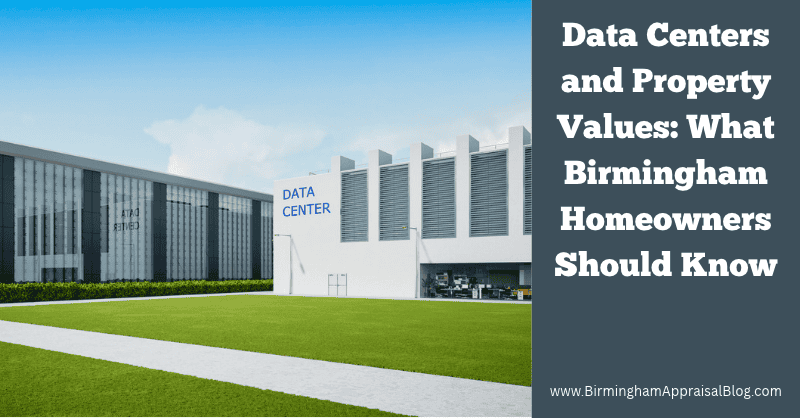
If you are a homeowner or real estate agent, you may be wondering how data centers could affect property values, especially for homes located nearby. At the present time, there is no definitive answer, and I’m not writing this article to provide either a positive or negative spin on the topic because there’s not enough data to say one way or another.
What I am here to discuss is what is happening locally as well as how other parts of the country are being impacted by data centers in their area. Lastly, and most importantly, I would like to discuss how appraisers think about this topic and how it might be handled in an appraisal of your property if you are near a facility.
Before we get into the research, let’s take a look at what is happening now in the Birmingham, Alabama area.
Proposed Data Centers in the Birmingham Area
At the current time, there are two major AI data centers in the Birmingham, AL area that are either being built or proposed. One is off of Lakeshore Parkway, and the other is in the Bessemer area. I should note that DC Blox has an existing data center in Birmingham; however, it is not a dedicated AI factory like the other two and is much smaller. It is reported to have an operating capacity of 5 megawatts.
The Nebius AI Factory is under construction off of Lakeshore Parkway in the former Regions Operations Center. This facility will house a data center approximately 300 megawatts in size and located on approximately 75 acres.
Project Marvel is still in the planning stages and will be located in the Bessemer area near the intersection of Interstate 459 and I-20/59. This facility was initially supposed to be situated on 700 acres; however, the developer has since requested rezoning of an additional 900 acres. It is proposed to be a 1,200 megawatt data center encompassing 18 buildings.
Because this is such a new concept for this area, local municipalities are scrambling to develop ordinances to regulate these types of facilities. Nearby Columbiana passed regulations that require sound studies, landscape buffers, and height limits on the buildings before anything can be built.
With all of this happening in Birmingham and surrounding metro areas, it’s natural to wonder if it could have any impact on home values. In order to do this, we need to look at other areas that have existing data centers to see what the impact has been.
What National Research Shows
Since data centers are new to the Birmingham market, it’s difficult to know how these two proposed developments will affect home prices. When you have limited data in one area, the next best thing you can do is look to other areas that have already experienced what we are about to go through.
Northern Virginia is said to be the largest data center market in the country. There have been market studies done to determine the data center’s effect on nearby home values; however, the results are mixed.
Various studies done by George Mason University give contrasting results. One study showed that homes closer to the data centers sold for higher prices; however, another study showed that new data centers also slowed local home price growth.
In Texas, where data center activity is increasing, home prices fell by a little over 8% in the past year; however, it is not known if this was caused by the presence of the data centers themselves or if it had more to do with other local market forces.
Another study by the University of Rochester showed that there was negligible impact on home values. Many of these studies do seem to contradict themselves, but I think it is important to keep in mind the newness of all of this, and the fact that it may be too soon to tell what the long term effect will be.
Something to consider and keep in mind is the psychology of both buyers and sellers. Some buyers may be reluctant to purchase a home in close proximity to a data center, and some sellers may want to quickly sell their home for fear that the data center will contribute to declining property values.
Some people may be worried that construction noise, increased traffic, and the center’s impact on water and electricity may have an adverse effect. Others may see it as an opportunity because of more jobs, more home buyers (from those filling the jobs), a stronger tax base, and improved infrastructure.
In other parts of the country where large data centers have been around longer than here in Birmingham, there have been some positive influences. Data centers generate a lot of property tax revenue.
These taxes do not come with the same pressures that new residential development does. With new homes, you typically have a larger strain on schools and other public services; however, that is not the case with data centers.
In other parts of the country, the taxes collected from data centers are as high as 20-25% of the entire county’s tax base. This could possibly translate into improved services and infrastructure improvements.
Whether these concerns end up affecting property values depends on how buyers respond in the marketplace. At this point, there simply isn’t enough evidence in Birmingham to know.
Since the national research gives us a limited understanding of the exact impact of data centers, we need to understand what factors actually matter when it comes to how a data center may affect the homes around it.
What Factors Matter? An Appraiser’s Perspective
Regarding data centers, it’s important to keep in mind that not all of them are the same. There are varying sizes, such as the DC Blox that I mentioned previously. This facility is smaller and has an operating capacity of 5 megawatts compared to Project Marvel, which is rated at 1,200 megawatts.
The facilities necessary to support these two totally different centers are the difference between night and day. DC Blox is located near downtown Birmingham and does not take up much space; however, Marvel will be located on approximately 1,600 acres, which is significant.
The impact from each of these types of data centers can vary substantially. The smaller one may have only negligible impact; however, the larger one could be far greater.
A good comparison might be a small industrial building on the outskirts of a neighborhood compared to multiple Walmart supercenters’ worth of server farms. The impact is totally different.
The distance between a house or subdivision and the data center can affect its influence on property values. It all depends on what factors you are looking at. With a data center, several things come to mind. These include sound, the view, and potential increases in traffic.
Each of these factors has the potential to influence nearby home values, and the effect would typically become less noticeable with distance. If the data center is having a measurable influence, a home directly across the street could be affected differently than one a mile away. Just because a data center is in the general area does not mean that all home values would be affected.
So what might homes in close proximity to the data center experience? In other parts of the country, homeowners living near data centers have reported concerns about continuous equipment noise. The sound is something that they constantly hear in the background.
This may not matter to some homeowners, but others may find it annoying. From an appraisal perspective, our job is to measure how this affects a home’s value, which I will cover later in this article.
The value of your home is also influenced by the view. Typically, views like the ocean, mountains, or a golf course are positive factors. On the other hand, views such as the interstate, airport, or a city dump can potentially have a negative impact.
With data centers, you are typically getting large, industrial looking buildings. This is not something that most people find attractive or desirable to look at. Again, this would only impact property values of homes within view and would not have the same effect for homes further away.
Any time construction is in the area, you are going to have heavier traffic. This happens in new subdivisions when the neighborhood is not yet built out. During the construction of data centers, there is going to be heavier traffic of vehicles associated with construction; however, after construction is complete, this typically goes away.
So how would an appraiser actually analyze something like this? Let’s look at the process.
How an Appraiser Approaches This
If the market shows that a data center is having a negative effect on nearby property values, this could fall under a concept appraisers call external obsolescence. This term refers to a loss in value caused by something outside the property’s boundaries that the homeowner cannot control or fix.
Since the negative influence is outside of the property’s boundaries, the only way to fix the problem is to pick up the house and move it to another location. While some houses can be moved, this is not a route most people take.
Think about a home next to a busy interstate, a railroad track, a large warehouse, or beneath high-voltage power lines. The house itself may be in excellent condition, but its location may be the main influence for what buyers are willing to pay.
A large data center located next to a residential neighborhood could fall into this same category, especially for the homes closest to it.
I’ve written about external obsolescence in more detail in another article, which you can read HERE. For this post, I want to focus on how an appraiser determines whether a data center is actually influencing home values.
The first step is to look at the market. Appraisers don’t begin with the assumption that a data center has either a positive or negative effect. We look for market evidence.
One way to measure that influence is through paired sales analysis. We try to find two homes that are as similar as possible in size, age, condition, quality, and other important characteristics. The primary difference is that one is located near the data center while the other is not.
If buyers consistently pay less for homes located near the data center, that difference may indicate the market recognizes an external influence. If there is little or no difference, the market may be telling us the data center is not having a measurable impact.
Another possibility is that paired sales may not be needed at all. In this situation, the subject property and all of the comparable sales are located in the same neighborhood near the data center. Since every property is in the same neighborhood or subdivision and subject to the same outside influence, it is already reflected in the sale prices of the comps.
In that situation, there may not be a need to make a separate adjustment for the data center. The market has already recognized it in the actual sale price paid for the comparable property.
In some neighborhoods, the income approach may provide another way to measure the impact. If a neighborhood has a significant number of rental properties, an appraiser can compare rental rates in neighborhoods located near the data center with similar neighborhoods farther away. If homes near the data center consistently rent for less, that may indicate the market recognizes an influence. On the other hand, if rents are similar, it may suggest tenants are not placing much weight on the data center. Of course, if all of the rental data comes from the same neighborhood near the data center, there would be no reason to make a separate adjustment because that influence is already reflected in the market rents.
The challenge we currently have in the Birmingham area is that these proposed data centers are still new. Some are in the planning stages while others are just beginning construction.
If I were appraising a home near one of these proposed sites today, I would recognize the possibility of an external influence and analyze the market carefully to determine whether buyers are reacting to it. As more homes sell, appraisers will be in a much better position to determine whether buyers are paying less, paying more, or showing no measurable difference for homes near these facilities.
It isn’t an appraiser’s job to decide whether a data center is good or bad for a neighborhood. Our job is to analyze the market and report what buyers and sellers are actually telling us through their actions.
If you own a home near one of the new or proposed sites, here are some things you might want to keep in mind.
What Homeowners Near a Proposed Site Should Know
If you live near where a data center is proposed or being built, there are several things worth paying attention to. I would be careful about relying too heavily on rumors or assumptions because what actually happens may be very different from what people expect.
It is a good idea to pay attention to how these projects develop and what the local regulatory response looks like. For example, the City of Birmingham enacted a 6 month moratorium to evaluate environmental impacts, address community concerns, and establish proper zoning rules. It’s possible that these developments, like zoning regulations, could have a positive impact on property values.
In addition, the regulations may require greater transparency by requiring pre and post construction noise studies to ensure that requirements are met.
This is one reason it’s important to follow how these projects develop and what regulations are put into place. Things like noise requirements, landscape buffers, setbacks, and other regulations could reduce some of the concerns homeowners have about living near a data center.
The best thing to watch is the housing market itself. As more homes sell near these facilities, we’ll have a better understanding of whether buyers are reacting to them and, if so, how much.
Conclusion
Data centers are coming to the Birmingham area, and we’re going to learn a lot more about their impact as these projects progress. The important question isn’t whether they’re good or bad. The important question is how buyers respond to them. That’s ultimately what determines market value. As appraisers, we’ll continue to watch the market, analyze the evidence, and report what buyers and sellers are actually doing rather than relying on assumptions or opinions.
If you have any appraisal related questions, I can answer don’t hesitate to contact me, and as always, thanks for reading.
If you liked this post, subscribe by email (or RSS feed).


The “more home buyers from the people filling the jobs” part is worth splitting in two. We run a job board for traveling skilled trades workers, and on a build the size of Project Marvel most of the workforce is electricians, pipefitters and instrument techs who come in from out of state for the length of the job, draw $100-125 a day in per diem, and rent or park a camper the whole time. That crowd fills hotels and rentals, not the for-sale market, and then it leaves. The crew that stays on after commissioning is a small fraction of the construction headcount, which is a very different number for a housing analysis. If it helps to see the shape of it, the jobs these data center builds actually post show the rates and how long the work runs.
You do make a good point. I think what local communities must do is be better negotiators about what they will accept in their area. If these data centers want to be in these areas badly enough, the local governments need to make it work for them and the people who live there.
As someone who has been doing litigation in the real estate damages space for a long time, I think regression modeling is likely the best way to measure the impact of these facilities. This would allow an analyst to use a proximity variable or variables to measure impact relative to distance. I expect that as time goes on, we will likely see such studies in publications like The Appraisal Journal.
Hello, Michael, and thank you for sharing your thoughts. I can see where regression could be an effective tool to measure the potential impact of the facilities on property value. I’m hoping that as time passes, we will collect more and more data that will help us understand any potential impact they may have.
Data centers and flock cameras are the two major topics today. Haha. Relevant stuff here, Tom. I’ll be curious to see how much value data centers can add to a local economy. Or do they just drain energy?
Yeah, it will be very interesting. After publishing my post, I saw another article about how data centers will become obsolete 4-5 years after they are built, based on how fast technology is changing. Also, that’s funny that you mention Flock cameras. Before this week, I did not even know what one was, but I was educated by my son, who told me how they are in the news. The times, they are a changin.