Why Pricing a Home Has Become More Challenging
Over the past 12 months or so, we have seen a gradual reduction in mortgage rates. Rates have bounced around with normal fluctuations; however, the general trend has been downward.

Within this time period, rates were the highest in May of 2025, and as of March 12, 2026, they were at 6.11%. They recently dipped below 6% into the 5s, a rate at which some believed many buyers would get off the fence and buy a home.
Since dipping below 6%, rates have increased again, this is most likely due to the war in Iran. We really don’t know how long the war will last or what lasting impact it will have on future rates.
With all of this being said, one thing is for sure: the market is more precise than it was in the past. Your home must be priced to the market and not a pie in the sky number that doesn’t align with the comparable sales.
During COVID, pricing was up in the air as many homes would sell for over list price due to multiple offers as a result of increasing demand and limited supply. That was a unique time and one that is totally different than what we are in now.
Buyers are very savvy due to all of the data available at their fingertips via their phones. They know the general price range a home should be listed at based on what other homes are listed and sold for.
Why Condition Matters More in Today’s Market
One thing that stands out in today’s market is how much more attention buyers are paying to condition. During the COVID market, buyers were often willing to overlook condition just to secure a home. That is not the case today.
Buyers now have more options and more time to compare homes. Because of that, differences in updates, finishes, and overall appeal can have a noticeable impact on what they are willing to pay.
When pricing a home, it is important to consider how it compares in condition to other available homes. If there are noticeable differences, those differences should be reflected in the price.
What I’m Seeing in Today’s Market
With buyers being extra concerned about pricing, condition, and updates, it’s more important than ever for sellers to be more precise in the pricing of their homes. It must line up with the market i.e., the homes it will be competing with.
Within the Birmingham area, which includes both Jefferson and Shelby counties, median prices increased in 2025 over 2024, no doubt caused by the limited supply of homes. The number of home sales has increased in small increments over the past 3 years; however, we are still not where we were before COVID.
Two stats that caught my eye for 2025 were the number of listing cancellations and the slight increase in day on market (DOM). The Greater Alabama MLS does not give a reason for the cancellation; however, we can assume that it was either because the seller got cold feet and decided to take their home off the market, or because it was priced too high to begin with, and the listing was cancelled and relisted.
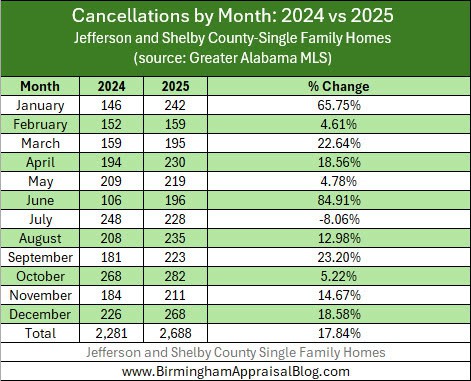
While we may not be able to convince a seller to keep their home listed, we can do our best to price their home accurately so that it sells within a reasonable time period for the highest market-supported price based on its features and condition.
The Key to Pricing a Home: Selecting the Right Comparable Sales
Agents and appraisers have similar goals when trying to price and appraise a home. Their goals are accomplished by answering the same question, and that is “What other homes would a buyer realistically consider if this property were not available?”
We are both looking for good substitutes for the subject property. The following are characteristics of a good comparable sale:
Similar Market Area
There are different levels of a market area. You can narrow it down to the subdivision or neighborhood, or expand it to a greater area commonly referred to as a competitive market area.
When I get calls from real estate agents asking what they should do when they cannot find sales, I ask them where they are looking. They invariably tell me that they are looking in the subdivision, and no recent sales have occurred.
While it would be nice to be able to find recent sales from within the subdivision, it may not be as easy as that. Over the last several years, the number of sales has declined as interest rates increased.
Because of this, we have a smaller pool of sales to pull from. If you cannot find recent comparable sales within the subdivision or neighborhood, it is acceptable to expand the boundaries to encompass a larger competitive market area.
A competitive market area is one that would be similar to the neighborhood where the house you are pricing is located. It would be in the same school system, have similar quality homes, similar size homes, and be in a similar price range.
There is one last thing I would like to mention about the distance of sales. While it is preferable to have sales from within the same subdivision or neighborhood, we must also keep in mind that distance alone is not the best search criterion.
This is an important concept to remember:
Comparable doesn’t mean nearby. Comparable means similar.
I have had sales on the same street as homes I’ve appraised; however, due to physical differences, such as size, condition, or amenities, they would not be good comps; sale, yes, but comp no.
Similar Physical Characteristics
Choosing sales that are the most similar in physical characteristics will give a more accurate indication of value. Buyers typically look for a house based on its square footage, number of bedrooms and bathrooms, amount of land, as well as its age or condition.
One method to help when choosing comps is that of bracketing. This method emphasizes using comps that bracket the square footage of the home.
An example would be having a 2,000 sf home that you are pricing. Ideally, you would choose sales that are larger, smaller, and similar in square footage. The larger homes would be adjusted down, the smaller homes would be adjusted up, and the similar-sized homes would not require any adjustment.
This would decrease the price gap between the sales and provide a narrower indication of value for the subject property. By doing it this way, the estimate of value reflects the physical characteristics of the property.
Recent Sales
Choosing sales that have occurred the most recently will give the best indication of value because they reflect what is currently going on in the market. In addition, using sales that are competitive with the subject property helps to reflect buyer behavior and what they are willing to pay for homes with similar physical characteristics.
If you choose to look for sales that are in the same price range as what you think the property will sell for, you will most likely find sales that support your assumption. This is a form of confirmation bias that leads us to search for sales that confirm our pre-existing assumption about the property’s value.
Information That Helps the Appraiser
 If you’ve done your homework with a CMA in pricing the home, and you have information from the seller about any updates and renovations that were done, why not put it together into an “Appraiser Information Packet“? This can help the appraiser by providing useful information in a clear, organized format that highlights recent upgrades, relevant comparable sales, and any unique features that may not be immediately obvious during the inspection. Ultimately, it supports a more informed and efficient appraisal process, reducing the likelihood of overlooked details and helping the property be evaluated as accurately as possible.
Here are the items I suggest including in the packet:
- List of updates or renovations
- Sales you used in your CMA (and maybe even sales you looked at but didn’t use)
- Information on multiple offers or backup contracts
- Anything that supports the contract
The first three items are pretty straightforward, but I might need to explain the fourth. Some neighborhoods have important characteristics or are located near schools or other prime features.
Agents get a better idea of what moves the needle for buyers because they deal with them daily, whereas appraisers have very little contact with buyers. This information should also be passed along, as it gives the appraiser insight into what motivates buyers to pay what they do.
Some neighborhoods are popular in the Birmingham metro area because they are located in close proximity to schools where kids are within walking distance. If this motivates a group of buyers to pay more, then it could be a key factor in their offer and should be shared.
The key point I’m trying to get across here is that appraisers can only consider information they know about, so providing this information can be helpful. Keep in mind that the appraiser will perform their due diligence during the appraisal assignment in finding sales, considering the features and conditions of the property, as well as analyzing sales data, but the information you provide in the packet can be helpful as well because it helps them understand the mindset the agent went through when pricing the property or writing up the contract.
How to Avoid Appraisal Surprises
So let’s say that you’ve done your homework. You’ve priced the home based on market data, and you’ve provided a stellar appraiser information packet, but the appraisal comes in lower than the contract. What should you do?
I’ll back up for a minute here and say that the best thing to avoid this situation is to be proactive and make sure you communicate with the appraiser upfront before they finish the report. Make sure you let them know that you’re available to answer any questions they may have and be available if they contact you. Any communication done after the appraisal is submitted usually has to be through the lender, which can cause delays in the home sale transaction.
The first thing you should do is review the report for factual inaccuracies. Make sure the information about the property is correct because if it is not, it could materially affect the final opinion of value.
If the property is located on 5 acres but the appraisal only shows 1 acre, this is something that can be corrected and will impact the value. Also, look at the comps for anything that may not look right.
If your home is located on a golf course, but the sales are not, and no adjustment has been made, this is also something that deserves an explanation. If an adjustment should have been made, this could result in an adjustment to the final value.
Because these types of issues occur after the appraisal is completed, a “Reconsideration of Value”, or ROV, must be submitted to the lender, who then provides it to the appraiser. This may or may not result in an adjustment to the appraisal value.
Agents can reduce the likelihood of appraisal issues by selecting truly comparable sales based on the criteria I previously mentioned. In addition, recognizing differences in condition and size will help pricing be more reflective of what buyers are paying for similar properties, which will then help your list price be more accurate.
A Simple Way to Think About Pricing
One simple way to approach pricing a home is to look at it from a buyer’s perspective.
Ask yourself what other homes a buyer would realistically compare this property to. If the home you are listing does not stack up the same way in terms of size, condition, features, or updates, the price should reflect that.
Thinking this way can help bring clarity to the pricing process and reduce the likelihood of surprises later in the transaction.
Final Thoughts
If agents follow the same process appraisers use, they’ll usually land on similar comps. That should tighten up the gap between list price, contract price, and the appraised value, and cut down on any big appraisal surprises.
If you have any questions, don’t hesitate to contact me, and as always, thanks for reading.


Nice post Tom. Out here in the Sacramento region, we’ve had a drop of 20% in sales volume by pre-pandemic standards because of reduced demand/affordability issues. It’s swinging towards a buyer’s market, with condition and location big issues for buyers. Plus, if you get the list price wrong, the home sits. Sounds like the same as in your market. Good advice to sellers.
Thanks, Joe! Yeah, pricing is key. Especially in the market we’re in now. It’s always nice to see what’s going on in other markets as well.
I dig the cancellation stats. Nice job, Tom.
Thanks, Ryan! The cancellations really surprised me but it’s good do see these numbers to help agents focus on pricing to help prevent this.